
Custom Hockey Jersey Buying Guide for Teams
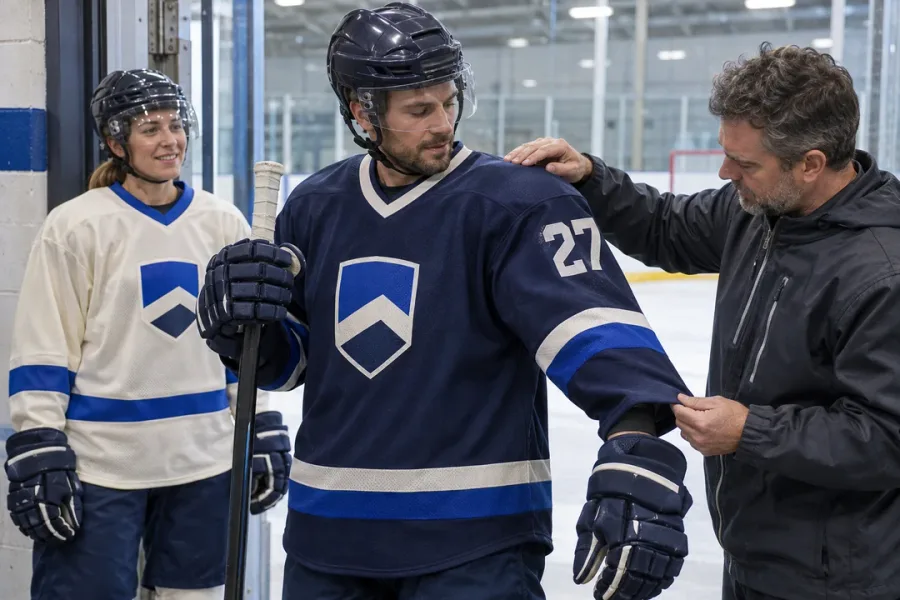
A custom hockey jersey order starts with three decisions. Identify which games or practices the jerseys will be used for, check how each cut fits over the team’s actual pads, and lock a roster that connects every size to the correct name and number. Send that information with the artwork and the date the team needs to receive the order. When you compare suppliers, ask them to price the same specification and agree on a physical sample before committing to the full run.
Define the uniforms your team actually needs
List the planned use for each jersey. A game order may include home and away versions, while a practice order may use two contrasting colors so coaches can split lines. A reversible jersey can combine two looks in one garment, but check the fit and weight of the finished reversible sample. If a tournament requires its own patch or color combination, keep that version separate on your order sheet. Browse practice hockey jerseys and reversible hockey jerseys for examples of the two approaches.
Before designing the layout, pull the uniform rules for the league, age division and event the team actually plays in. Record permitted jersey colors, number placement and any restrictions on nameplates, sponsor marks or captain letters. The International Ice Hockey Federation publishes its current rulebook and event regulations online. A school league or local tournament may apply its own requirements. Save the relevant rule or the organizer’s written answer with your design file. IIHF rules and regulations
For example, a club entering two events might need a dark game jersey, a light game jersey and a separate light practice top. If an event requires a visible back number, confirm that your practice and game rosters do not get mixed during ordering. Label each version by its use and color. In a quote request, “dark game, navy with white numbers” gives a supplier more to work with than “design A.”
Measure over the gear the players will wear
Start with a jersey that fits one of your players well while wearing the correct pads. Lay it flat without stretching it and record chest width, body length and sleeve reach. Ask the supplier to mark the same measurement points on its size chart. A sleeve measured from the center back will produce a different number from one measured from the shoulder seam. Identify every dimension as a flat garment measurement or a body measurement before comparing charts.
Have players try the sample over their own shoulder and elbow pads. Ask them to reach forward into a skating stance, lift the elbows and turn through the shoulders. Check where the cuffs meet the gloves and how far the hem rises when both arms extend. The jersey should allow the player to move freely, with enough room for the pads and the length the team expects. If a player is between sizes, test both with their gear before assigning a size on the roster. The hockey jersey measuring guide explains common measurement points.
Run a separate try-on for goalies. Their pads can change the room required through the body, sleeves and armholes. Ask for the goalie pattern and chart even if the supplier uses the same letter size for both cuts. Record “goalie cut” on the roster and check a dressed goalie sample. The goalie-cut hockey jersey guide covers the construction differences in more detail.
Compare fabric, construction and decoration together
Ask how each sample is built. Request the fabric composition and weight, panel layout, cuff and collar construction, and a close view of the inside seams. If the garment has a mesh panel, ask where it sits once the jersey is stretched over pads. Compare the garments at the same fit and under the same conditions. A fabric swatch can help you judge color and hand feel, while a sewn jersey shows how the seams, fabric and decoration behave together.
Dye sublimation transfers a design into compatible fabric using heat. It suits full-panel artwork such as stripes, gradients and numbers printed as part of the design. Review the sewn sample where stripes cross panels, particularly under the arms and across the sleeves. Also check that the chest crest and back number remain easy to read once the jersey drapes over pads. Epson dye-sublimation printing primer
Sewn crests, twill numbers or separate nameplates have a different appearance and change how the decorated panel feels. Ask for a close-up of the stitch path and backing, and check the decorated sample on the smallest cut in the order. A proof can show the intended size and placement, while a physical sample shows the material thickness and how the finished edge sits. Compare examples on the sublimated hockey jerseys and hockey jersey nameplates pages.
Make the artwork readable from across the rink
Create a separate proof for each uniform version. Mark the crest size, back number height and reference points for placement. Include an example of the widest two-digit number and the longest surname on the smallest jersey cut in your order. Check the same details on the goalie cut if that pattern has different seams or sleeve proportions. Ask the supplier to show front, back and both sleeves, even if one view contains only a stripe or a small patch.
Look at the sample in arena lighting or similar conditions. Stand far enough away to read it at the distance a coach, timekeeper or spectator would see it. Compare the home and away versions side by side, and look again after taking a photo. Color references and a physical swatch help with matching, especially when a stripe is repeated across the jersey, socks and pants. Confirm which artwork file and color reference the supplier will use if the two differ.
Hand off artwork the supplier can reproduce
Ask the supplier which artwork files it can use at production size. A vector crest lets it resize the mark without losing edge definition. If you have a raster image, send the best available original and ask the supplier to flag any details that might blur or disappear. Keep a labeled copy of the sponsor and club artwork approved for this jersey. If a sponsor changes mid-season, the next proof should state whether it replaces or adds to the existing mark.
When a jersey design includes embroidery or stitched lettering, check the smallest readable detail with the decorator. Fine strokes in a screen proof can be hard to reproduce at small sizes. Ask for the crest or name sample at its finished size so the team can approve the real border, lettering and placement.
Build a roster and specify how changes work
Use one row per player, uniform version and cut. Include the printed name, number, size, player or goalie cut, version and quantity. Leave optional fields explicitly blank or use a note such as “no name.” If your rules permit a number with a leading zero, format that column as text so a spreadsheet preserves it. Check for duplicate numbers within each team and confirm accented letters against the written roster before proof approval.
Separate spare jerseys from named player jerseys. Record their cut, size and intended number, and decide whether they should have blank name areas. Ask which roster file is attached to the production order, who must approve it and when changes can still be made. When a player joins late, send an updated sheet with a new revision number and identify the exact rows that changed. Keep the artwork proof and roster revision together so both sides can compare them later.
Compare quotes against the same order
Send each supplier the same quantities, cuts, artwork details, destination and target arrival date. Ask for a breakdown of sampling, artwork or setup, personalization, size surcharges, packing and freight if any apply. Confirm the minimum order for each design and what it would cost to add one replacement in an existing style. If you are ordering across borders, confirm which delivery charges, taxes or duties are included in the quote.
Distinguish the date a supplier can dispatch from the date the jerseys must be in your hands. Work back from the first game through transit, final checks, production, sample revision and artwork approval. Ask which parts of the schedule start after payment, proof approval or sample sign-off. Get the agreed milestones in writing and leave room to correct a proof or sample before the order is due.
Check the supplier’s remedy for a wrong size label, a swapped player name or a color discrepancy. Ask what evidence the supplier needs and when you have to report the issue. Agree on how jerseys will be labeled or grouped for distribution. For a club with several age divisions, packing by team and version makes it easier to spot a wrong jersey before it reaches a player.
Prepare for mid-season replacements
Ask what the supplier retains from the initial order and how long the pattern, artwork and fabric are likely to remain available. A reorder should specify the original sample or purchase reference, the cut, the fabric and the decoration version. Ask whether a replacement produced separately can be checked against the original color reference. If a fabric or component is discontinued, review a new swatch before approving the substitution.
Keep the club’s blank-spare plan separate from its personalized reorder plan. A blank jersey can cover a last-minute fitting issue if it suits your league rules. A named replacement needs a fresh roster entry and proof. Decide who on the team can approve those requests after the first order so the process stays clear when the season is under way.
Approve a production sample and inspect the delivery
An artwork proof confirms the design, colors and roster layout. A physical pre-production sample lets the buyer inspect fabric, construction, measurements, drape and decoration. Agree which sample represents the order and identify any changes to apply after approval. Keep a dated copy of the approved measurements and take photos of the sample laid flat, on a player in pads and at a distance.
When the order arrives, count jerseys by team and version before distributing them. Compare names, numbers, size labels and cuts against the approved roster. Inspect a selection from different cartons and sizes, including any goalie or reversible jerseys. If you find an issue, record the affected rows and photograph the garment next to the approved sample or proof while the labels are still attached.
What to send with your first inquiry
- Team name, intended use, league or event and date the jerseys must arrive.
- Quantity by version, size range, and expected number of goalie and spare jerseys.
- Team colors, usable artwork files, and placement requirements for names, numbers and logos.
- A current jersey to match, a size-chart reference, or measurements from players wearing pads.
- Delivery destination, packaging needs and any replacement or reorder questions.
If your team is still comparing styles, start with the ice hockey teamwear collection. When the basic requirements are ready, send your hockey jersey brief to Martin-Fox and identify the decisions you want to make before ordering.